Case studies / 01
Pettito / Fidavio · AI Transformation · Consumer Finance
Using AI to reimagine a legacy retail business model.
How Pettito used AI, data, and product transformation to move upstream into lending, improve the economics of its core business, and create the foundation for an entirely new fintech platform.
The financing value chain
01 · The dependency
A successful retail business, with the valuable half of the transaction owned by someone else.
Financing already played an important role in Pettito's business. Customers often relied on point-of-sale lending to complete purchases, but Pettito did not own the financing relationship.
Third-party point-of-sale lenders underwrote the customer, originated the loan, held the receivable, and serviced the account. Pettito received its portion of the underlying transaction, but much of the value created after the sale remained with the lender.
That structure solved an immediate customer need. It also placed an increasingly important layer of Pettito's economics outside the company.
Who owned each stage of the financing value chain
Stages 02–05 sat with third-party point-of-sale lenders.
Pettito created the customer demand. Most of the financing value was captured outside the business.
Economics
Financing upside flowed outside the business.
Pettito participated in the original transaction, but much of the economics associated with lending were captured elsewhere.
Control
The financing experience depended on someone else's platform.
Approval criteria, loan structures, and the customer financing journey were constrained by third-party providers.
Data
The learning loop lived outside Pettito.
The connection between applicant characteristics, offers, repayment behavior, and loan performance accumulated primarily with the lender.
02 · The reframe
The financing layer was strategically important. Pettito didn't own it.
The obvious question was how to make financing work better.
The more important question was whether Pettito should continue outsourcing a capability that was increasingly central to customer conversion, unit economics, and long-term enterprise value.
Initial question
How do we improve the financing experience?
Strategic question
How do we own more of the financing layer?
That reframing changed the scope of the work. Instead of optimizing a third-party financing process, the opportunity became to determine whether AI, software, and data could enable Pettito to move upstream into underwriting, origination, and servicing, and eventually turn that capability into a platform other operators could use.
What if financing became a capability Pettito owned?
03 · How the work ran
Seven stages, one inflection point.
01
Challenge
Understand where value was being created and where it was leaving the business.
02
Assess
Evaluate lending economics, workflow, customer experience, data, risk, and operating constraints.
03
Frame
Reposition financing as a strategic capability rather than an outsourced checkout feature.
04
Redesign
Rework underwriting, offers, customer choice, and the operating model around the new capability.
05
Build
Create AI-assisted underwriting, configurable offers, and the supporting product experience.
06
Deploy
Connect decisioning with origination, servicing, and real operating workflows.
07
Scale
Turn an internal capability into the foundation of a platform for other operators.
Stage 03 is the inflection point. Everything downstream was scoped differently because of it.
04 · Building the capability
Turning the strategy into an operating capability.
The transformation required more than a model. It required connecting underwriting intelligence, lending economics, operating policy, and customer choice into a usable system.
Two experiences sat at the center of the new model.
Fidavio Underwriting Console
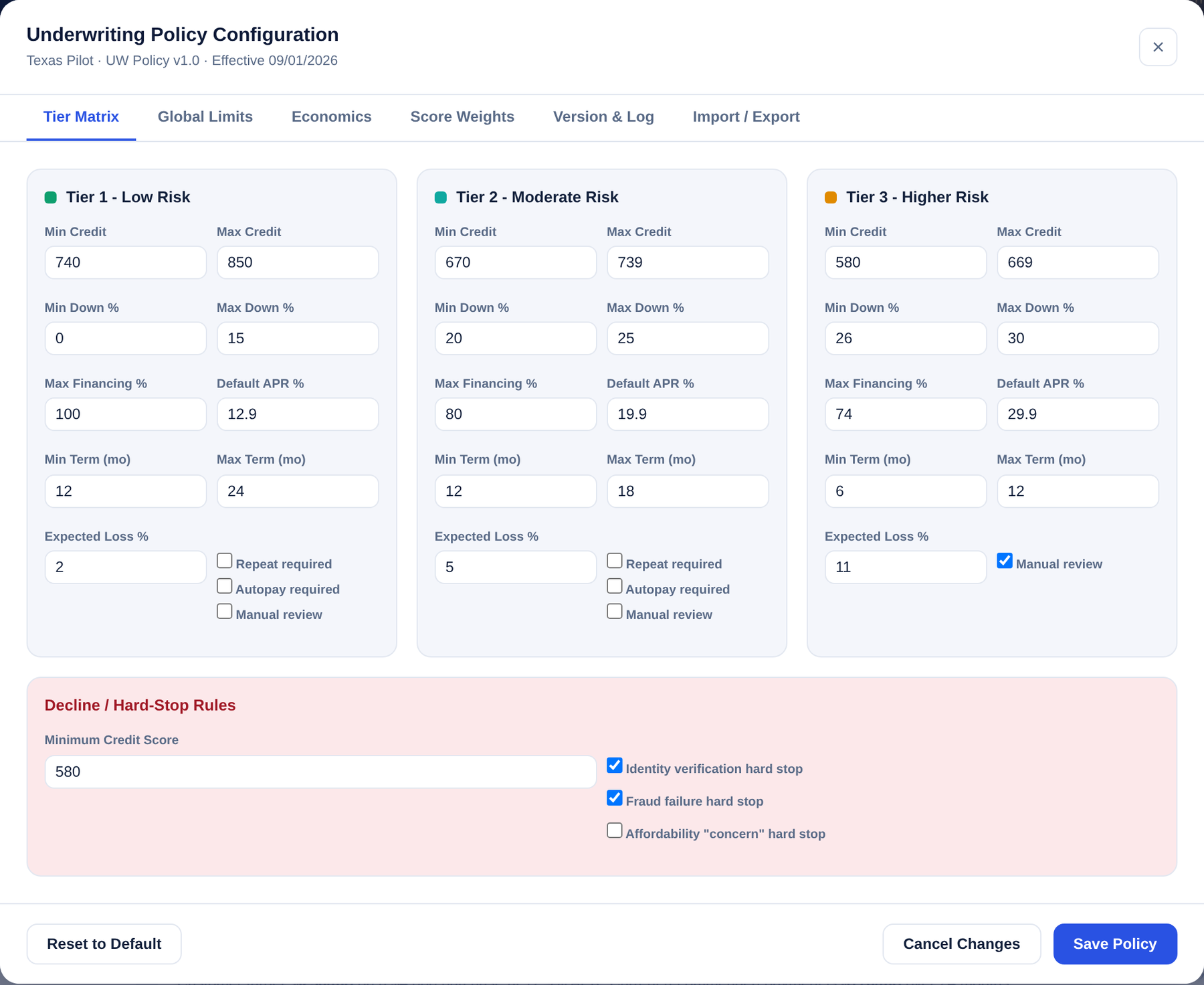
The internal underwriting environment brought together customer attributes, policy logic, risk indicators, transaction economics, and offer construction in a single workflow.
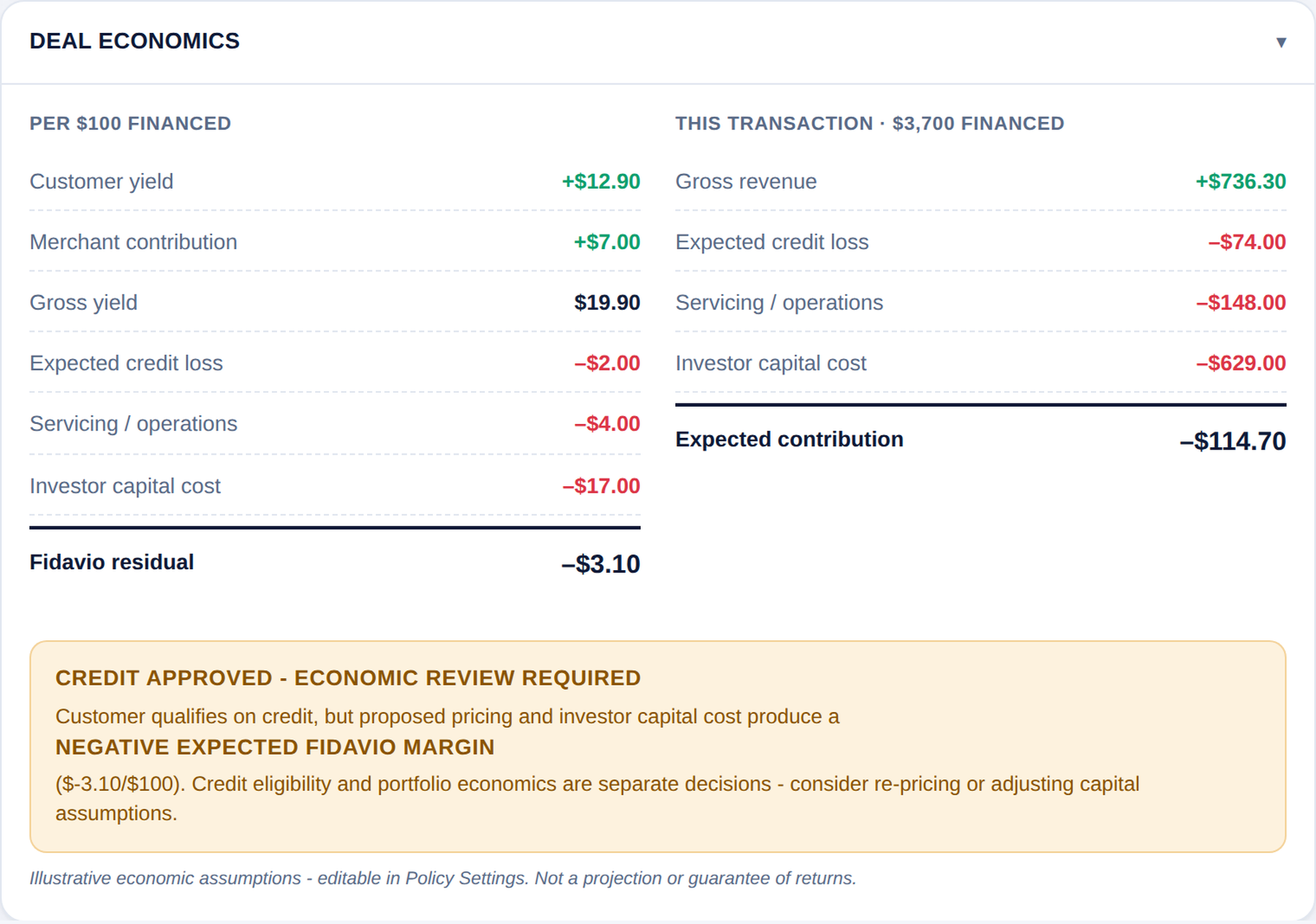
Rather than producing only an approve-or-decline result, the system helped operators understand what offer could be made, why it could be made, whether it remained within policy, and what the economics of that transaction looked like.
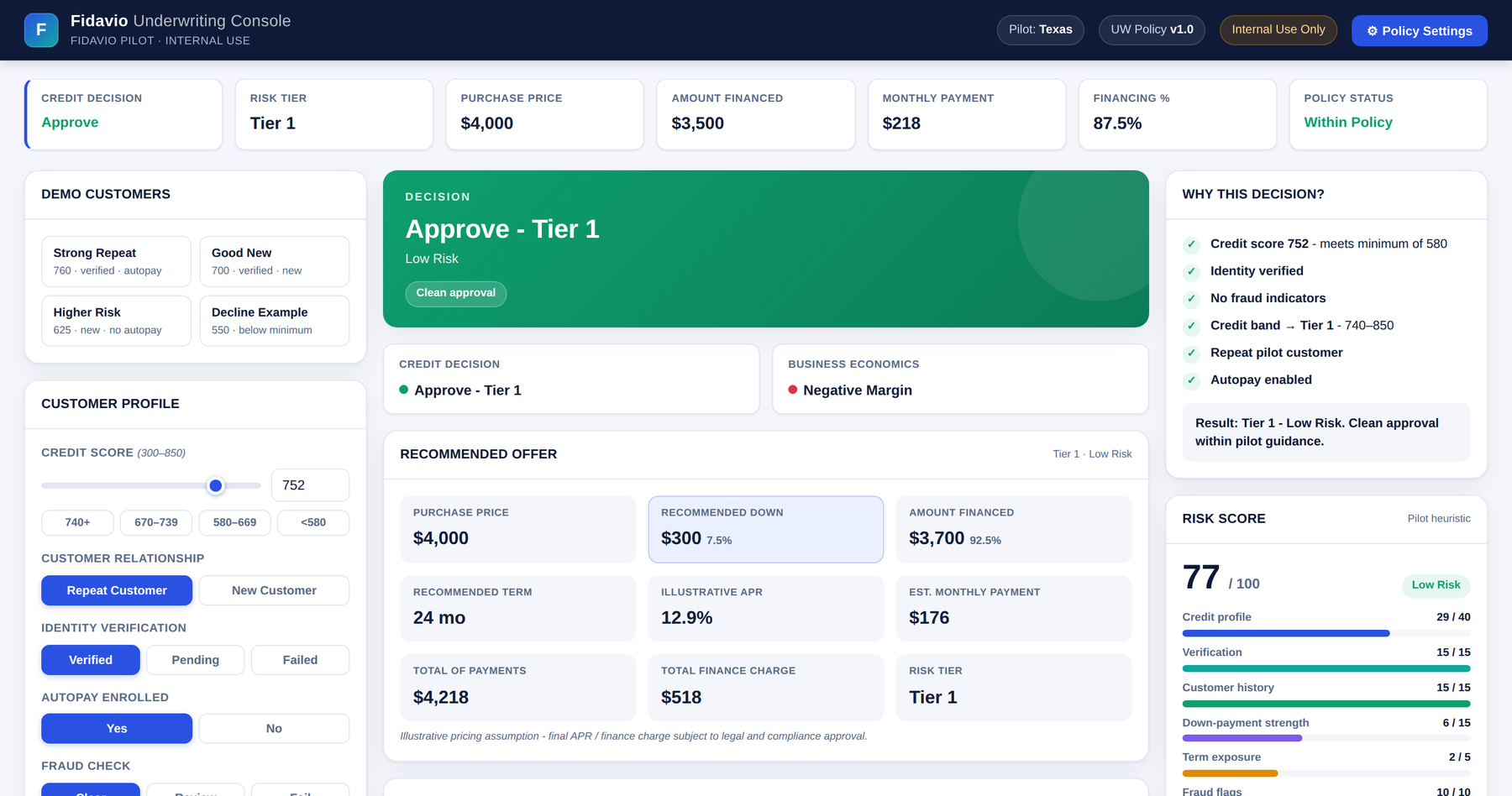
Decisioning
Risk-tier and credit-decision support.
Offer design
Recommended down payment, financing amount, term, APR, and monthly payment.
Exceptions
Visibility into cases that required policy review or human judgment.
Economics
Credit decisions considered alongside the economics of the transaction.
The customer side of the same decision
The internal decisioning capability was paired with a customer-facing experience that translated underwriting constraints into understandable choices.
Customers could evaluate tradeoffs between down payment, loan term, and monthly payment while remaining within the structures supported by the lending policy.
The same intelligence that supported the underwriting team became the foundation for a better customer financing experience.
Your purchase
$4,000
$750
$0$2,000
24 months
12 mo36 mo
Estimated monthly payment
Illustrative reconstruction. Figures shown are for explanation only and do not represent an offer of credit.
One decision engine, two experiences
The engine
Fidavio decisioning
Underwriter experience
Risk
Policy
Economics
Exceptions
Customer experience
Term
Down payment
Monthly payment
Amount financed
Viable loan offer
Origination + servicing
These were not two disconnected interfaces. Both read the same policy and the same economics.
05 · Where value sits now
Move upstream and own more of the value chain.
Building Fidavio changed Pettito's position in the financing ecosystem. Instead of participating only in the retail transaction and handing the financing relationship to an external lender, Pettito could now participate more directly in the lifecycle behind the loan.
Before
After
The same five stages. The difference is how many of them Pettito participates in.
Pettito stopped treating financing as a checkout feature and began treating it as a strategic capability.
The transformation was not simply about replacing one lender or making underwriting faster. It changed where Pettito could participate in the value chain and what capabilities the business could own.
What Pettito held before
- Retail economics
What Pettito holds after
- Retail economics
- Financing economics
- Servicing economics
- Proprietary performance data
06 · What the new platform opens up
The capability Pettito built for itself describes a problem other operators share.
Many specialty merchants generate customer demand but rely on external lenders to provide the financial infrastructure behind the transaction.
Once Fidavio had been built to support underwriting, offer construction, origination, servicing, and performance data for Pettito, the same capability could become a product for businesses facing the same structural problem.
What began as an internal transformation created the foundation for a new platform.
Fidavio as lending infrastructure
Pettito
Original operator. In production.
Similar operators
Specialty merchants with the same structural dependency.
Future verticals
Additional categories and partners.
Large sponsor banks and capital partners
A filled marker denotes an operator in production. Open markers denote prospective participants, not current relationships.
As origination and servicing activity grows, Fidavio can provide financial partners with increasingly rich visibility into underwriting decisions, borrower behavior, and portfolio performance.
Owning more of the lending lifecycle also changes the quality of the data Pettito and Fidavio can accumulate. Instead of seeing only the original sale, the platform can increasingly connect the underwriting decision and loan structure with what happens afterward: repayment behavior, performance, losses, and portfolio economics.
That creates a learning asset that becomes strategically more valuable as the platform scales.
The compounding loop
01
More originations
02
Richer performance data
03
Better underwriting and pricing
04
Greater value to operators and capital partners
↩ returns to 01
At the centre: the Fidavio data asset. Applicant attributes, offer structure, credit decision, payment behavior, losses, portfolio performance.
07The outcome
A stronger core business, and the foundation for another one.
Before
A retailer that created financing demand for someone else.
Held retail economics only
Credit decisions made on a third-party platform
Loan performance data stayed with the lender
One business, one revenue stream
1 of 5 stages
After
An operator that owns the lending lifecycle.
Holds retail, financing and servicing economics
Underwriting policy configured in-house
Loan performance data retained and compounding
Fidavio can be sold to other retailers as a second business
5 of 5 stages
The Proofline perspective
The AI opportunity wasn't “automate underwriting.”
It was to change where the company captured value.
Pettito could have used AI to make one workflow incrementally faster. Instead, the opportunity was framed as a business-model transformation.
The most valuable AI opportunities are often not the places where AI can replace a task. They are the places where AI, software, and data make a fundamentally better business model possible.
Proofline helps leadership teams identify where AI can change the economics of the business, not simply where it can automate a task.
Where is the constraint in your business?
The details differ, but the starting question is usually the same: where could AI materially change the economics, and what needs to be true before you invest?